
What Is A Spend-To-Win Retreat?
The short answer
A spend-to-win retreat is a retail campaign in which customers who spend above a set threshold are entered into a draw to win a brand-hosted retreat. The incremental basket uplift funds the campaign, and the trip itself produces a content library the brand owns. Holistic Way ran this structure at Takashimaya in Singapore and returned eleven times the campaign cost from a three-day activation.
The term describes a specific mechanic, not a style of trip. If you take only one thing from this page: the prize is the marketing budget, and the spend threshold is what turns it into revenue.
What is a spend-to-win retreat, exactly?
A spend-to-win retreat has four moving parts. You set a spend threshold above your normal average basket. Customers who cross it during an activation window are entered into a draw. The winners travel on a brand-hosted retreat alongside selected creators and a production crew. The footage from that trip comes back as brand assets you own.
What separates it from an ordinary competition is that the prize is a production shoot wearing a holiday's clothes. The trip is scheduled, staffed and shot-listed like a campaign, because it is one. A giveaway ends when the winner posts a photo; this ends with a highlight film, a set of cutdowns and customer testimonials.
- Spend threshold
- The basket value a customer must reach to enter. Set above your current average, by a margin reachable with one extra item.
- Activation window
- How long the mechanic runs in store or online. Three days is enough if footfall is concentrated; a fair or a launch week is ideal.
- Prize retreat
- The trip itself: flights, accommodation, ground logistics and itinerary, hosted and branded by you.
- Content deliverable
- What the trip produces. A brand highlight film, a cutdown set, and testimonial videos featuring the actual winners.
- Usage rights
- How long you can run the footage as paid media. One to three months as standard, extendable if quoted upfront.
Why does the mechanic pay for itself?
Because of an asymmetry that discounting does not have. A discount reduces the value of every single transaction in the window, whether or not the shopper needed the incentive. A prize costs the same fixed amount whether ten people qualify or two hundred, and every one of those qualifying baskets has been pulled above its normal size by the threshold.
A discount scales its cost with your success. A prize does not. That single difference is the whole commercial argument.
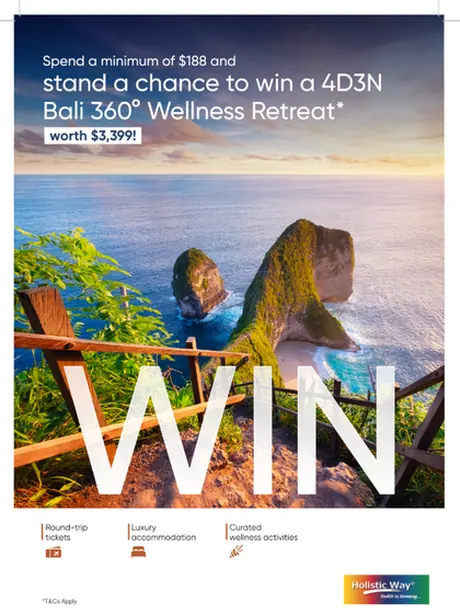
Holistic Way is the worked example. Shoppers who spent SGD 188 on Holistic Way supplements at the Every Body Knows Fair at Takashimaya entered a draw for a 4D3N Bali wellness retreat worth SGD 3,399. Across three days the mechanic produced more than 170 qualifying purchases and more than SGD 32,000 in retail revenue. That is eleven times the campaign cost, before counting the content that came back from Bali.
How does a spend-to-win retreat pay for itself?
The prize is a fixed cost regardless of how many customers qualify, while the spend threshold lifts every qualifying basket above its normal size. Set the threshold above your current average basket and the incremental retail revenue covers the campaign, before you count the content library you keep afterwards.
How do you set the spend threshold?
This is the number that decides whether the campaign works, and it is the one most brands get wrong in both directions. Too low and you are funding sales that would have happened anyway, and the mechanic becomes a rebate with extra steps. Too high and nobody qualifies, which produces no revenue and, worse, no winners and therefore no content.
- Start from your actual average basket in the category, not the blended store average.
- Add enough that reaching the threshold requires a decision, typically one additional mid-priced item.
- Sanity-check the qualification rate you would need for the incremental revenue to clear the campaign cost.
- Confirm floor staff can explain the mechanic in one sentence. If they cannot, simplify it rather than training harder.
We model those numbers against your own basket data before quoting anything, and we will say so if the arithmetic does not clear. A mechanic that needs an unrealistic qualification rate is not a campaign, it is a hope.
Does the destination affect the results?
More than people expect, and not in the direction they expect. The prize has to read as genuinely winnable to your customer. A 4D3N Bali or Phuket retreat from Singapore sits exactly in that band: aspirational, close, plausible. A flagship Paris or New York trip is more impressive and usually changes behaviour less, because aspiration that feels out of reach does not move a hand towards a shelf.
The short flight has a second effect that shows up after the draw. A prize that fits inside a long weekend actually gets claimed. A prize that requires a week of annual leave sometimes does not, and an unclaimed prize generates no content at all.
Which destination works best for a spend-to-win retreat?
Short-haul Asia: Bali, Phuket, Bangkok or Ho Chi Minh City, all under three hours from Singapore. The prize has to feel winnable to change shelf behaviour, and it has to fit a long weekend so winners actually claim it. Flagship long-haul destinations impress more and convert less.
What does a brand get that a voucher campaign never produces?
- Retail revenue in the activation window, measurable against campaign cost, the number finance signs off on.
- A brand highlight film and four to ten cutdowns, shot in one production window rather than briefed across a quarter.
- Up to three customer testimonial videos featuring real winners, which is the only form of proof that travels in trust-led categories.
- Your branding on the whole experience, from the welcome kits and signage to the itinerary and the film, rather than on a discount code.
- Customers who keep talking about it after they land, unprompted and without a media plan.
What is the minimum budget for a spend-to-win retreat?
Retreat packages start from SGD 20,000 for the full campaign, including flights from Singapore, accommodation, ground logistics, creators, production crew and the content deliverables. Below that we run local influencer campaigns and content production without the travel component.
When is a spend-to-win retreat the wrong answer?
When there is no purchase moment to attach it to. The mechanic needs a shelf, a checkout or an activation window; a pure brand-awareness objective with nothing to buy has nothing to threshold. It is also wrong when your budget is genuinely under the package floor. In that case a local influencer campaign without the travel component does more for the money, and we would rather scope that than push a trip.
And it is wrong if nobody internally will own the retail side. The trip is the easy part. The mechanic needs somebody who can get floor staff briefed and point-of-sale collateral in place, and without that the campaign is just an expensive holiday.